
Cass County Criminal Court Cases
Cass County court jurisdiction depends on the level of the filed charge. The Fifth Judicial District Court hears felony cases. The County Court at Law handles Class A and Class B misdemeanors and may receive other matters within its statutory jurisdiction. Justice courts and city municipal courts retain fine-only cases issued in their own jurisdictions. A Class C citation, therefore, should not be expected in the Fifth District felony docket.
The Cass County District Clerk identifies separate District Criminal and County Court at Law Criminal assignments. That office maintains the filed pleadings, orders, docket events, judgments, and sentences for those courts. County Clerk Web Access also offers a criminal-record search, but the public systems do not merge every Cass County criminal case into one universal index. A searcher must match the charge level and issuing court to the right clerk.
Cass County Court Routes
The most useful first choice is between felony and misdemeanor routes. Fifth Judicial District Court cases are coordinated through the district criminal division. County Court at Law matters go to its own criminal staff. Fine-only citations and related capias records remain with the justice court or municipal court that issued them. The distinction saves time because a cause number from one court may have no match in another system.
District Clerk Criminal Divisions
604 Highway 8 North
Linden, TX 75563
903-756-7514
Monday-Thursday, 8-noon and 1-5
Friday, 8-noon and 1-4
County Clerk Public Terminals
100 E. Houston Street
Linden, TX 75563
903-756-5071
Monday-Thursday, 8-noon and 1-4:30
Friday, 8-3:30
This two-building arrangement matters in rural Cass County. The historic courthouse holds County Clerk terminals, while the Law Enforcement & Justice Center holds the District Clerk and criminal courts. Call before driving, especially near the published noon closures.
Note: “The courthouse” can mean two different Cass County record stops, so confirm the custodian and building before an in-person visit.
Searching Cass County Case Records
Begin with the narrowest official channel that fits the case. Cass County posts dated docket documents, County Clerk Web Access supports criminal searches, and re:SearchTX indexes records from participating Texas courts. Coverage and document access vary, so no single screen should be treated as the complete Cass County case file.
- Identify the likely court from the charge level. Use District Criminal for felonies, County Court at Law Criminal for Class A or B misdemeanors, and the issuing JP or municipal court for fine-only matters.
- Check Cass County Clerk Web Access, accept its disclaimer, and choose the Criminal record category. Search by a name or known case identifier.
- Review the Fifth District or County Court at Law docket page for a scheduled setting. Save the cause number, court, and date shown.
- Compare the local result with re:SearchTX when statewide index coverage helps. Do not assume a missing document means the case does not exist.
- Contact the responsible clerk for the full file, a plain copy, or a certified judgment. Give the cause number whenever possible.
The Cass County portal presents several controls that help narrow a Cass County court record. Public access follows an acknowledgement screen rather than a private subscriber login.
| Field or Control | Type | Required | Use |
|---|---|---|---|
| Accept disclaimer | Button | Yes | Opens the public access site. |
| Record category | Menu | Yes | Select Criminal rather than OPR, probate, or marriage. |
| Name | Text | One search path | Check identity details because common names can match. |
| Case or instrument ID | Text | Alternative | Use an exact number from a notice or docket. |
| Date range | Date controls | No | Shortcuts run from Today through Last Month. |
Cass County Dockets Are Schedules
A docket PDF answers a narrow question: which matters are set before a court on a stated date. It is not a party-name database or a complete history of everything filed. Prior hearings, later resets, motions, exhibits, plea papers, and final judgments may not appear on the sheet. For that reason, a docket hit should become a route to the clerk, not the end of the search.
Cass County publishes a Fifth Judicial District docket page. The official page image below shows the local source to use for scheduled felony matters.
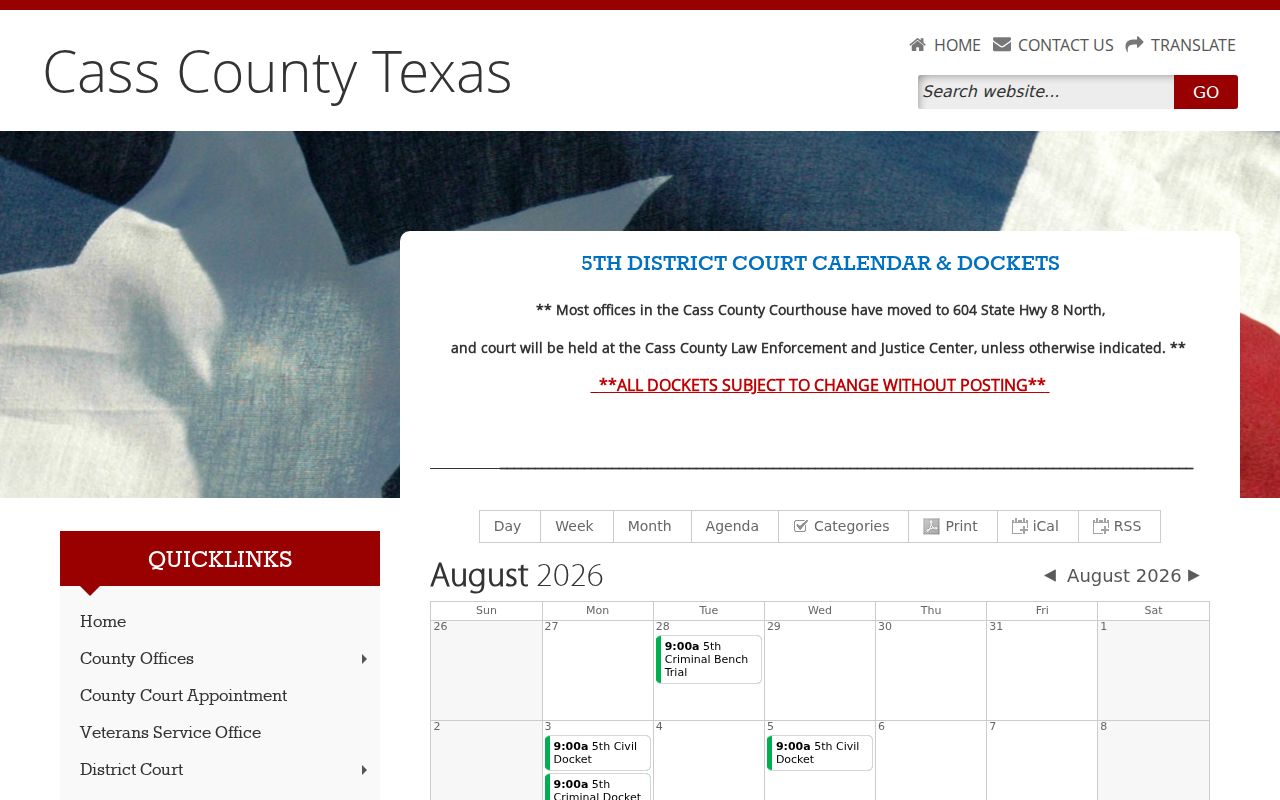
Record the date and cause number from the docket, then ask District Criminal staff for the actual Cass County court file. The County Court at Law docket page supplies the parallel schedule source for its criminal calendar.
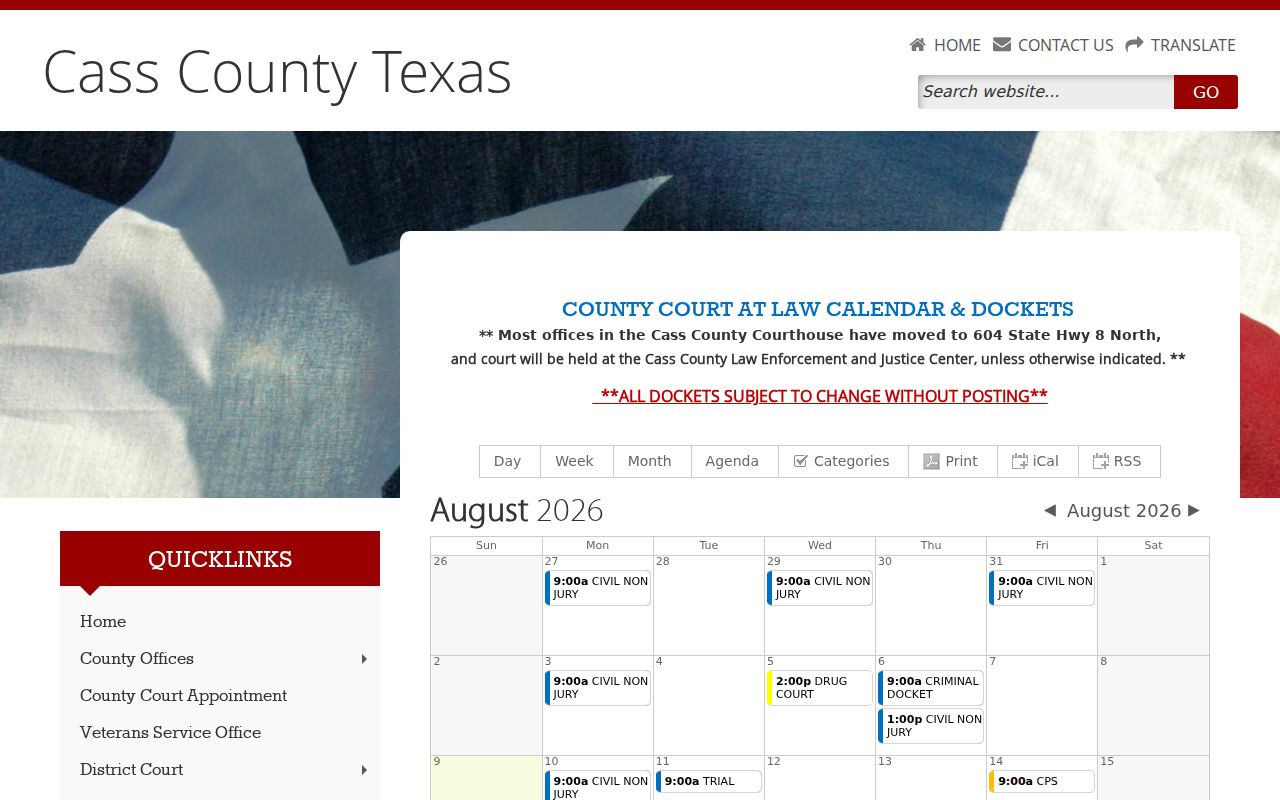
Its placement on a separate page reinforces the need to know which Cass County court holds the case.
Inside a Cass County Case File
A Cass County criminal case file is organized around a cause number and a specific court. It may contain the complaint, information, or indictment that states the filed charge; docket entries that record court activity; bond and counsel orders; motions; the plea; and the final judgment. The initial booking allegation can change before filing, so the charging instrument and judgment carry more weight than a jail label.
| Cause Number and Court | Identifies the particular prosecution and the court responsible for the file. |
|---|---|
| Charging Instrument | Shows the offense actually filed through a complaint, information, or indictment. |
| Docket Entries | List settings, appearances, motions, pleas, and orders recorded by the clerk. |
| Bond and Counsel Orders | Document release conditions and attorney appointments when filed. |
| Disposition and Judgment | State whether the case ended in dismissal, acquittal, deferred adjudication, or conviction. |
| Sentence and Costs | Record confinement, community supervision, restitution, costs, or other ordered terms. |
One person can have several cause numbers, and one arrest can produce several counts. Save the exact court, offense wording, disposition date, and document title. Similar names alone are not sound identity proof.
Certified Cass County Judgments
An online entry is useful for locating the case, but it is not the same as a certified copy. A certified judgment carries the clerk's authentication and is the best local record when the final result matters. The County Clerk schedule lists plain criminal copies at $1 per page and certification at an added $5 per document. The research did not locate a current District Clerk criminal-copy tariff, so confirm that office's cost before ordering.
The County Clerk does not accept copy requests by phone and does not fax copies. Fees must be prepaid before mailing. Online copies can be purchased by card, while counter payment rules differ. The clerk also warns that web images may be unavailable during backups and that staff are not required to perform an ordinary criminal search. Use the public terminal or portal first, then provide a precise cause number.
Note: Buy a certified Cass County judgment when authenticity matters; a portal summary or docket schedule does not certify the final outcome.
How a Criminal Case Moves
A Texas case can start with an arrest and Article 15.17 magistration, but a filed prosecution begins when the proper charging paper reaches the court. A complaint may support early proceedings. A prosecutor may file an information for a misdemeanor, while a grand jury may return an indictment for a felony. Arraignment is the formal charge-and-plea stage. Pretrial work follows, then a negotiated plea or trial, a disposition, sentencing, and a possible appeal.
Cass County case flow: Charges Filed › Arraignment › Pretrial › Plea or Trial › Disposition › Sentencing
Terms can be easy to misread. A disposition is the outcome. Deferred adjudication withholds a finding of guilt during supervision, but it is not an acquittal. A no-bill means the grand jury declined an indictment. A dismissal ends the filed charge without a conviction, while an acquittal is a not-guilty result after adjudication.
Cass County's First 48 Hours
After an arrest, Texas law requires magistration without unnecessary delay and no later than 48 hours. The magistrate gives warnings, addresses counsel information, reviews probable cause as required, and considers bail. This first stage can create records before the prosecutor has settled the final charge. It explains why an intake label may not match a later Cass County indictment or judgment.
Cass County JP1 publishes magistrate-hearing information and a duty calendar, a local point in the case timeline. Still, the JP record is not automatically the Fifth District case file. Follow the cause and filed charging paper to the court that takes jurisdiction. Readers moving from booking data to formal charges can compare Cass County's arrest lookup channels with the clerk-held criminal case.
Case Record Access & Restrictions
The Texas Public Information Act governs access to many agency records, but court case contents come from the clerk responsible for the case. Texas Rules of Judicial Administration Rule 12 concerns judicial administrative records, not the pleadings and judgment in a criminal file. The official Texas courts access policy shown below helps mark that boundary.
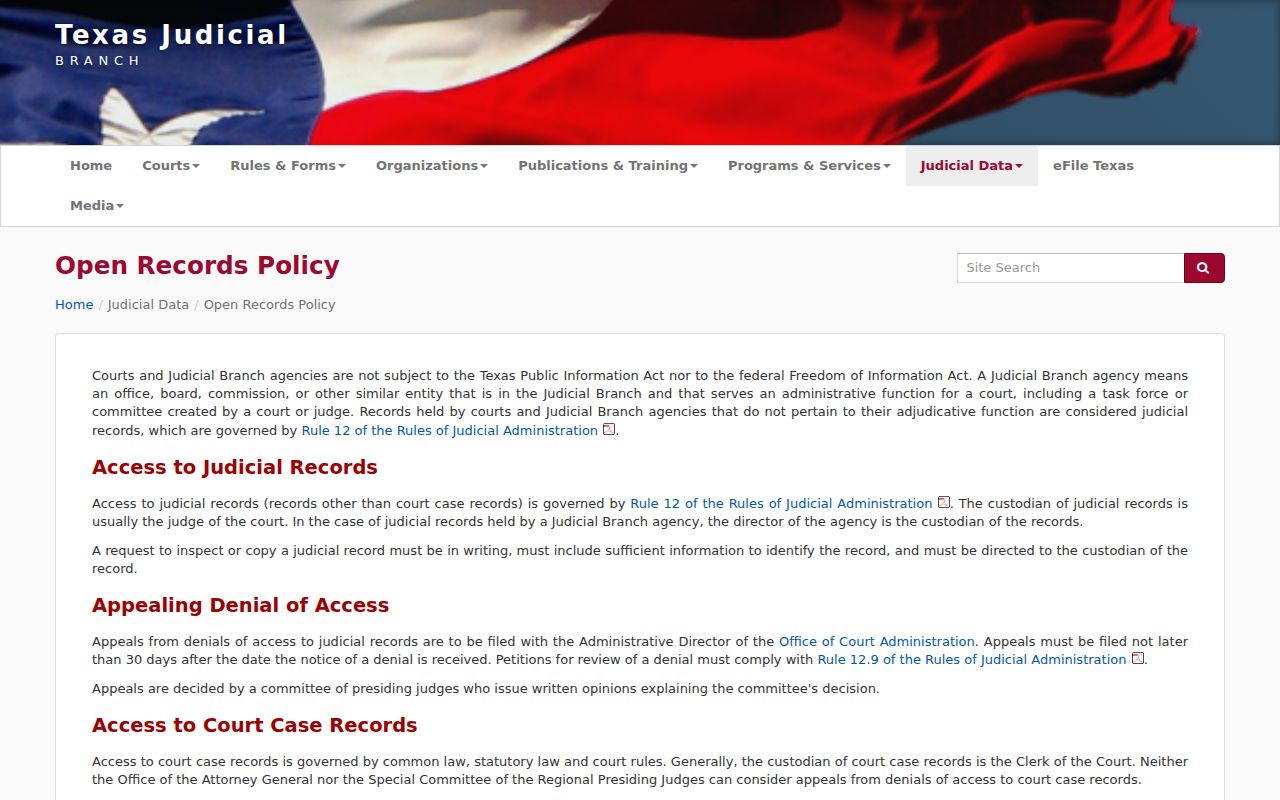
For a Cass County prosecution, send the case-file request to the relevant clerk rather than treating an administrative-record request as a substitute.
Public access also has limits. Juvenile law-enforcement and court material, sealed or nondisclosed records, protected victim details, living persons' full birth dates, driver's-license numbers, and financial data may be withheld or redacted. Grand-jury deliberations remain secret. An online omission can reflect those restrictions, a backup, limited portal coverage, or a file that belongs to another court.
Missing Cass County Court Files
When no online file appears, do not treat the blank screen as proof that no Cass County criminal case exists. First confirm spelling, the filing year, and any cause number. Next check whether the matter belongs to District Criminal, County Court at Law Criminal, a justice court, or a municipal court. A docket PDF may reveal a setting even when document images are not online.
Then call the District Clerk at 903-756-7514 for felony or County Court at Law file routing. For County Clerk material, use the public terminals at 100 E. Houston Street. re:SearchTX can provide another index layer, but participating-court coverage and account permissions vary. If the case was expunged or protected by an order of nondisclosure, public access may lawfully be restricted under Government Code Chapter 411.
The state law source below describes criminal-history dissemination, which is distinct from direct access to a clerk's Cass County case file.
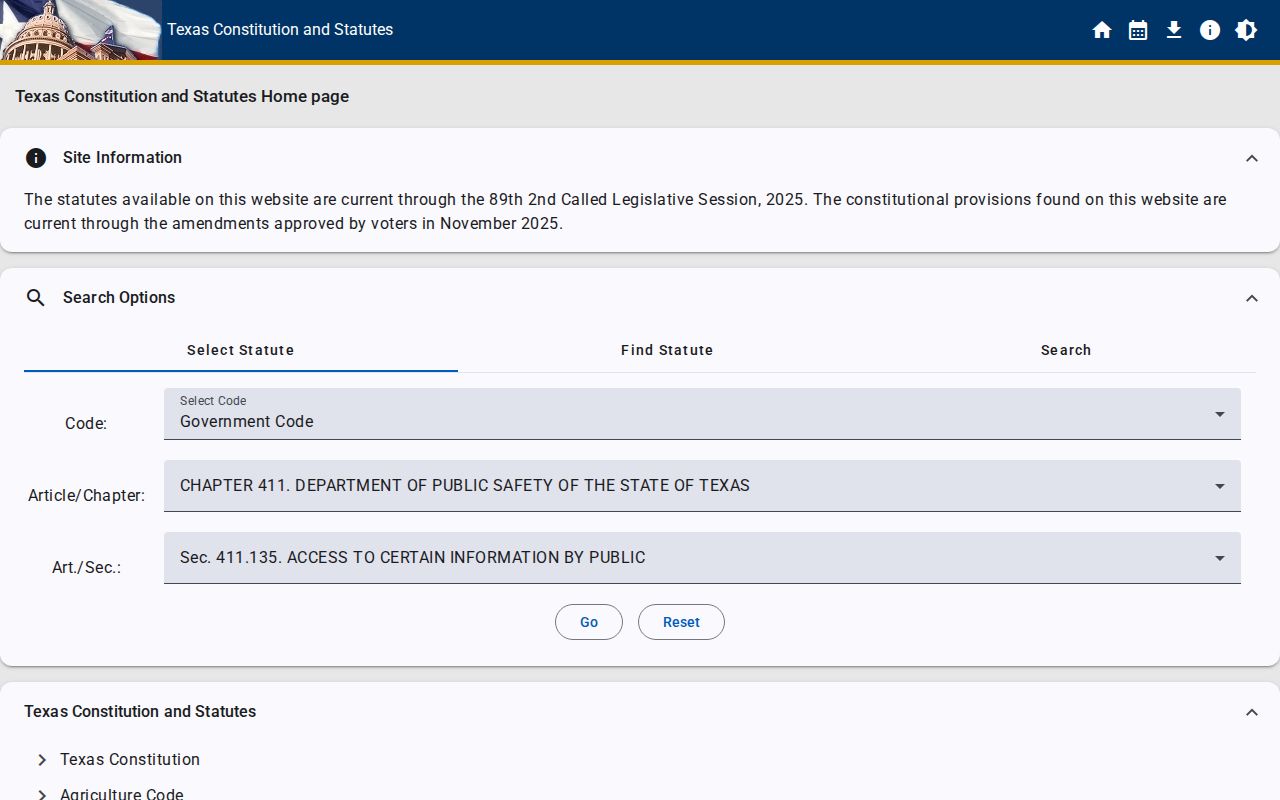
That distinction prevents a common error: a narrow DPS public result should never replace the local judgment and docket when tracing one Cass County prosecution.